

NEWS: Murdi Paaki Regional Housing Plan Documents Systematic Health Hardware Failures Across 17 NSW Communities—Nine Healthy Living Practices Framework Quantifies $435M Infrastructure Deficit
A regional housing and environmental health plan covering 17 Aboriginal communities across far western NSW explicitly uses Healthabitat’s Nine Healthy Living Practices as the assessment framework for documenting property condition and repair needs. The Murdi Paaki Regional Housing and Environmental Health Plan, published December 2022, surveyed 1,291 Aboriginal social housing properties and found four in five dwellings requiring urgent repairs, with 30% needing moderate work and 12% requiring extensive restoration.
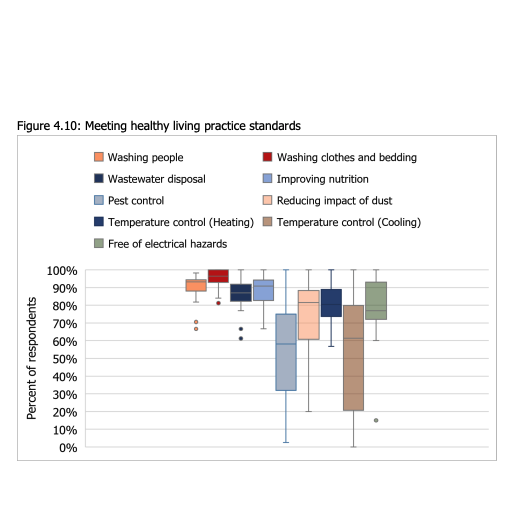
Broad compliance with the standards associated with the Housing for Health nine healthy living practices (HLPs) is shown at Figure 4.10 using surrogate indicators. Page 26
The Plan was developed through the Regional Aboriginal Housing Leadership Assembly as community-led evidence for policy reform. Household surveys asked tenants to report on health hardware function using HLP indicators: washing people (showers, baths, hot water), washing clothes and bedding (laundry facilities, washing machines), wastewater removal, food preparation and storage, crowding impacts, insect and vermin control, dust mitigation, temperature control, and trauma hazards.
Property Condition Data
Survey data demonstrated systematic health hardware failure. Structural movement from expansive soils caused cracking in walls and ceilings. Electrical and plumbing faults were common—rats eating cable sheathing, broken power points, exposed wiring, failed hot water systems, blocked toilets, running taps. Doors and windows were highly susceptible to damage, leaving tenants unable to secure properties. Single mothers in Coonamble reported rarely leaving home due to fear for possessions and safety.
Insect screens had short lifespans. Sliding windows bound in frames from worn rollers in the abrasive dusty environment. Mechanical cooling was inadequate in properties built for a different climate. Bourke is projected to experience temperatures above 35°C for four months annually by 2060-2079—within the design life of houses built now.
The Plan documented $57.65M in identified repair costs across the Region, averaging $47,000 per property. New housing demand was assessed at 540 properties ($268M). Property extensions to address crowding: 88 additional bedrooms ($3.11M). Home modifications for ageing-in-place and disability access: $536,000. Total investment required: $435M.
Closing the Gap Benchmark
The household survey measured compliance with Closing the Gap Target 9: 88% of Aboriginal people living in appropriately sized housing by 2031. Only three communities in the Region exceeded the target. Half fell seriously short. Wilcannia recorded the lowest compliance during COVID-19 outbreak conditions.
Data analysis demonstrated observable relationship between Aboriginal social housing supply levels and residential mobility (churn). Regression suggested up to 68% of local mobility related to inadequate housing provision levels. In Broken Hill, Aboriginal social housing accommodated one in nine Aboriginal households.
Existing housing stock and on-going maintenance is critical to the health and safety across these 17 communities.