

Reflection: Volunteer Housing for Health reflections
Dan & Emily reflect on their experience volunteering for 4 weeks across 3 projects in the NT.
Their invaluable backgrounds in health, architecture and construction were put to the test.
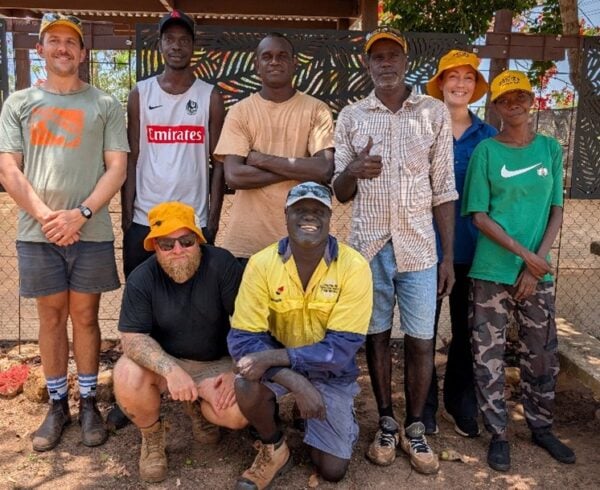
Image: Dan & Emily Volunteered for 4 weeks across 3 projects in the NT, they made great additions to our brilliant Yolgnu teams
“We were really impressed with the housing for health methodology, efficiency and planning that goes into the projects. With large numbers of local people collecting quality data, taking ownership of the project, fixing minor problems as we moved through the community and then seeing trades following up immediately (sometimes within the hour!).
This was really amazing and gave people the confidence that this wasn’t just another ‘housing check’. Things were happening.”
I (Dan) was first introduced to the work of Healthabitat at Architecture school at the University of Newcastle in 2013. Paul Pholeros introduced us to the idea of the 9 healthy living practices, but I’ve never had the opportunity to see these ideas be applied in practice.
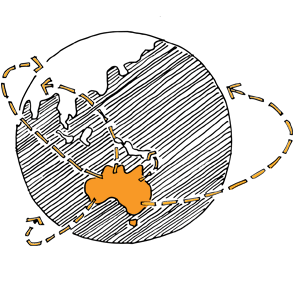
12 years later, after building our experience and skills across construction, architecture and health, we were fortunate to be able to volunteer on 3 projects in East Arnhem Land, NT, in October 2025 – of course we jumped at the opportunity.
Our experience was 2 fold;
We were really impressed with the housing for health methodology, efficiency and planning that goes into the projects. With large numbers of local people collecting quality data, taking ownership of the project, fixing minor problems as we moved through the community and then seeing trades following up immediately (sometimes within the hour!) This was really amazing and gave people the confidence that this wasn’t just another ‘housing check’. Things were happening.
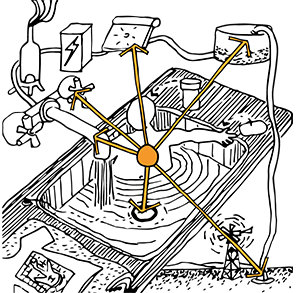
During the 3 projects across different 3 communities, we also got to see the notable difference in the functionality of essential services (plumbing, power, water, heating/cooling) when comparing a Survey-Fix 1 stage to a Survey-Fix 2 (sf2) stage about 6 months later. At the Sf2 stage people were very happy with the work that was done as part of Sf1, and generally we found far fewer problems. This process just goes to show the importance of regular maintenance. A lot of the items we saw to be faulty were generally low cost hardware items that have a real impact on health within the home.
The second part of our experience was the generosity of the Yolgɲu people. They welcomed us into their lives and helped us to understand the culture, showed us different ways a house will be occupied over time, and taught us some yolgŋu matha (language).
It is amazing to see the way Healthabitat workers were welcomed into the community and to see the large amount of local Indigenous people that are employed by the projects.
It was also amazing to see the way work, life, family/cultural commitments, music and art are all equally intertwined. Working shoulder to shoulder with the Community revealed the broad and critical roles of the Community workers in the project. Local workers often navigate the many layers of communication and organisation to share project information and schedule access to houses and ensure home owners are there to grant permission for the survey.
We filled our spare time with hunting/ exploring / music and learning, always lead by generous Yolgŋu people (who we would now call friends), taking us out for the whole weekend.
We met some very talented people and saw some beautiful places.
We look forward to our continued work with Healthabitat in the future.
Healthabitat would like to thanks Dan & Emily, and all our volunteers who not only work on the ground, but also behind the scenes across Administration, R&D, research, data and strategy.